
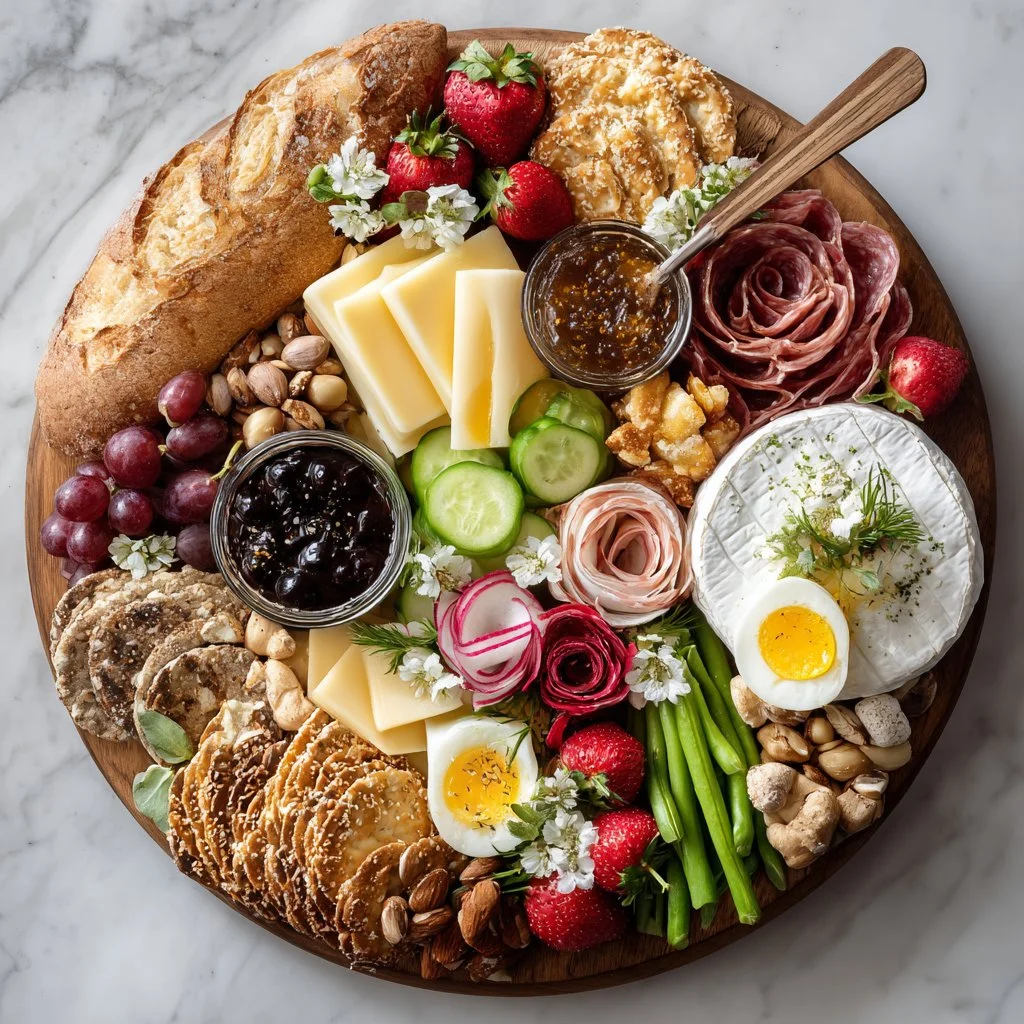
Bright, colorful, and effortless to assemble, this Spring Charcuterie Board brings seasonal freshness to any gathering.
It’s designed to be assembled in minutes, but it looks like you spent hours crafting it.
Perfect for picnic weather, bridal showers, or an easy centerpiece that guests can graze from.
Make one today and then tweak it next time to fit your mood or menu. Try pairing ideas from similar snack boards.
Why You’ll Love This Spring Charcuterie Board
- Fast to assemble with low-prep ingredients.
- Balanced sweet, salty, creamy, and crunchy bites.
- Visually stunning with edible flowers and herbs.
- Easy to scale up for crowds or down for date night.
- Kid-friendly options alongside adult flavors.
- Great make-ahead elements reduce stress on the day.
The tasting profile hits contrasts: tangy goat cheese and buttery brie, sweet fruit and floral honey, plus salty charcuterie for richness. Texturally it alternates creamy, flaky, crunchy, and juicy, which keeps every bite interesting and encourages mixing flavors on the cracker.
“This board was a hit at brunch — so easy and everyone loved the combination of honey with goat cheese. I’ll be making it for every spring gathering!” — 5/5
Key Ingredients for Spring Charcuterie Board
Choose a few hero items that set the tone. The quality of these will elevate the whole board and make simple crackers taste gourmet. For more visual layout inspiration, compare other boards as you plan: layout tips from similar snack boards.
Goat cheese (8 ounces, log)
Goat cheese brings bright acidity and a soft, spreadable texture that pairs beautifully with honey and fruit. Buy a fresh log labeled chèvre for the mildest tang; if you substitute cream cheese you’ll lose the bright lactic tang but retain spreadability.
Brie or Camembert (8 ounces, wheel)
A brie wheel adds a silky, melt-in-your-mouth center that guests love. Choose a double- or triple-cream for extra richness; if using camembert expect a slightly earthier flavor. Substitute a baked brie for a warm, oozy focal point.
Prosciutto (4 ounces, thinly sliced)
Prosciutto provides delicate saltiness and an elegant mouthfeel when folded into ribbons. Buy thin, dry-cured slices and keep them chilled until assembly; substituting smoked ham or serrano will change the flavor profile to smokier or more intense.
Strawberries (1 cup, halved)
Fresh strawberries add sweetness and color contrast that cut through rich cheeses. Pick firm, ripe berries but not mushy; frozen berries won’t work for texture, though dried strawberries can add chew if fresh options are limited.
Full Ingredient List for Spring Charcuterie Board
- 8 ounces soft goat cheese, log
- 8 ounces brie or camembert, wheel
- 6 ounces young gouda or Havarti, sliced
- 4 ounces prosciutto, thinly sliced
- 6 ounces salami, folded or shaped into roses
- 1 cup strawberries, halved
- 1 cup red or green grapes
- 1 cup sliced cucumbers and radishes
- 1 cup sugar snap peas or baby carrots
- 2 cups assorted crackers and baguette slices
- 0.5 cup mixed nuts (pistachios, almonds)
- 0.5 cup chocolate eggs, macarons, or cookies
- 0.25 cup honey or honeycomb
- 0.33 cup fig jam or berry preserves
- Fresh herbs and edible flowers, for garnish
Step-by-Step Instructions for Spring Charcuterie Board
Step 1: Place the cheeses as anchors on the board
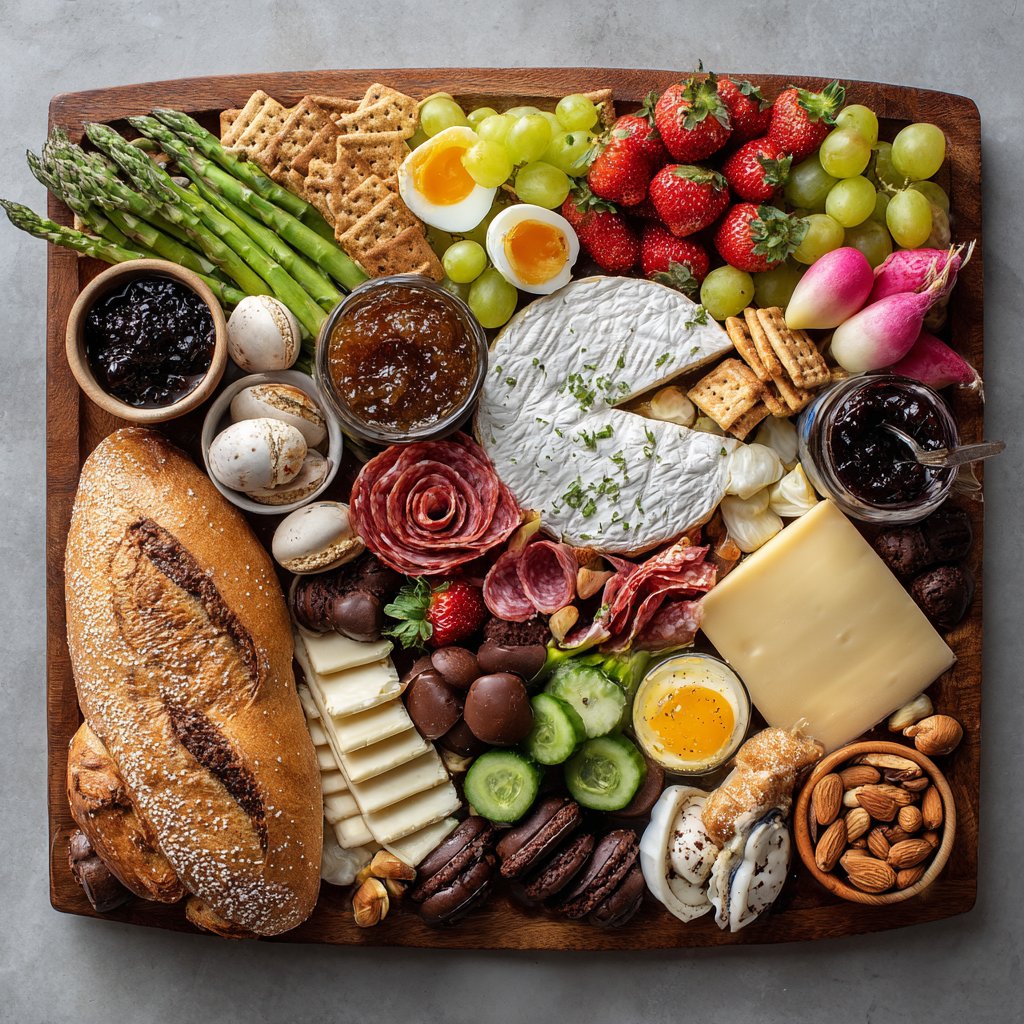
Set your board or platter on the work surface and position the brie wheel, goat cheese log, and sliced gouda apart in a triangle so each cheese becomes an anchor point. Leave space around each cheese for knives and tasting so guests can approach from multiple sides.
Pro Tip: The board should look balanced from above — three cheese islands with open space around them.
Step 2: Add small bowls for spreads and smaller items
Place small bowls near the cheeses for honey, fig jam, and any small nuts or candy so they don’t roll around. Keep spoons in each bowl and stagger heights for a dynamic presentation.
Pro Tip: Look for a trio of bowls clustered near the brie; the shine of the honey should catch the light.
Step 3: Fold prosciutto into ribbons and tuck it between cheeses and bowls
Gently fold prosciutto slices into loose ribbons or small rosettes and tuck them into gaps between cheeses and bowls to create soft curves and visual movement. Prosciutto draped over the edge of a bowl gives a deliberate, casual look.
Pro Tip: The prosciutto should look airy and ribbon-like, not flat; if it lies flat, refold for volume. See styling ideas for folded meats.
Step 4: Cluster strawberries, grapes, cucumbers, radishes, and snap peas
Group similar produce together in clusters around the meats and cheeses rather than scattering one by one; this creates color blocks and simplifies grazing. Keep fragile items like berries near the center so they don’t get squashed.
Pro Tip: The produce should form colorful clusters — a bright red patch, a pale green patch — not a random scatter.
Step 5: Fill remaining gaps with crackers, baguette slices, and nuts
Tuck stacks of crackers and fan baguette slices into remaining spaces; sprinkle mixed nuts in small piles to add crunch. Vary shapes and heights to avoid a flat surface.
Pro Tip: Crackers should be visible and accessible — think vertical stacks or slight fans that invite picking. A stacked presentation helps with access.
Step 6: Add finishing spreads and garnishes like honey and fresh herbs
Spoon fig jam into its bowl, place a shard of honeycomb or a small pot of honey, and scatter fresh herbs and edible flowers for spring color. Tiny garnish touches make the board feel thoughtfully composed.
Pro Tip: Garnishes should look fresh and fragrant; herbs should smell bright when brushed.
Step 7: Serve right away or chill briefly before serving
Serve immediately at room temperature for best flavor, or chill for 10–20 minutes if the kitchen is warm. If chilling, remove it 10 minutes before guests arrive to let cheeses soften.
Pro Tip: The board should smell fresh and slightly sweet from honey; cheeses should be soft but not runny. Timing tips for serving boards.
Expert Tips for Spring Charcuterie Board
- Temperature tip: Bring hard cheeses and meats to room temperature 20–30 minutes before serving for maximum flavor. Keep delicate blooms chilled until assembly.
- Texture troubleshooting: If crackers get soggy, serve them in small bowls off the board and replenish often to maintain crunch.
- Equipment tip: Use a variety of knives — spreader for goat cheese, small chef knife for slicing brie, butter knife for preserves.
- Common mistake: Overcrowding the board makes it hard to access items; leave negative space to guide guests.
- Visual tip: Use vertical elements (stacked crostini, small bowls) to add depth rather than a single flat plane.
- Flavor balance: Always include one bright acidic item (grapes or pickles) to cut through fat and one sweet item (honey, jam) to pair with cheese.
- Prep tip: Wash and dry produce thoroughly and pat dry to avoid excess moisture on the board.
- Serving logistics: If transporting, assemble most components at home but add fragile items and herbs on site for best presentation.
Storage & Freezing for Spring Charcuterie Board
Fridge storage: Store leftover components separately in airtight containers for up to 3–5 days. Keep cheeses wrapped in parchment or cheese paper inside a shallow container; sliced meats are best within 2–3 days.
Freezer storage: Most individual components can be frozen but the assembled board should not be frozen. Freeze extra gouda or salami slices in vacuum bags for up to 1 month. Do not freeze fresh berries; they lose texture.
Thawing: Thaw frozen cheeses overnight in the fridge, then bring to room temperature for 20–30 minutes before serving. Thaw meats in the fridge overnight; do not refreeze once thawed.
Reheating: No reheating needed for this board; if you bake a brie variation, reheat in a 350°F oven for 8–12 minutes until warmed through. Use airtight containers for fridge storage and freezer-safe vacuum bags for longer-term freezing.
Variations & Substitutions for Spring Charcuterie Board
Mediterranean Variation
Swap prosciutto and salami for marinated olives, roasted red peppers, and feta cubes. The board becomes briny and herb-forward, pairing well with crusty sourdough.
Vegetarian Variation
Omit all meats and double down on vegetables, roasted chickpeas, marinated artichokes, and halloumi slices. This creates a hearty, plant-forward grazing board that still has salty and savory elements.
Decadent Dessert Variation
Replace gouda with mascarpone, add more chocolate treats, candied nuts, and shortbread cookies. It turns the board into a sweet finale that pairs with coffee or dessert wine.
Low-Carb Variation
Replace crackers and baguette slices with cucumber rounds, endive leaves, and cheese crisps. The board remains texturally interesting while cutting carbs dramatically.
Frequently Asked Questions About Spring Charcuterie Board
What cheeses work best for a spring charcuterie board?
Choose a soft spreadable (goat cheese), a creamy wheel (brie), and a mild sliced cheese (young gouda or Havarti). These three provide a range of textures and flavors — tangy, buttery, and mild — so everyone finds a favorite.
How far ahead can I prep components for the board?
Prepare most components up to 24 hours ahead. Slice the cheese, wash and dry produce, and portion nuts and jams; keep delicate herbs and assembled flowers until just before serving to retain freshness.
How do I keep crackers from getting soggy under spreads?
Serve spreads in bowls and place crackers around them rather than under the spreads. Refill cracker stacks in small batches from a reserve container as the board gets eaten.
Can I make this board for a large crowd?
Yes — scale ingredients proportionally, use multiple boards for variety, and set up a second station with extra crackers and breads. For large gatherings, double the proteins and fruits per every 6–8 guests.
What’s the best way to transport a charcuterie board to a picnic or party?
Transport components in separate containers and assemble on site if possible. Use a shallow box or tray to prevent sliding; keep chilled items in coolers and add delicate garnishes last.
Final Thoughts on Spring Charcuterie Board
This Spring Charcuterie Board is flexible, fast, and beautiful — a simple formula for seasonal entertaining. Please leave a star rating in the recipe card below and pin this to Pinterest to save it for your next gathering.
For additional styling inspiration, check this lovely example of a Spring Charcuterie Board – Modern Honey.
If you’re planning a themed brunch, this floral-focused Springtime Charcuterie Board (perfect for Mother’s Day!) offers great variations.
Want a more rustic take? See the creative ideas in The Ultimate Spring Charcuterie Board – Sweet Tea + Thyme.